Welcome to the Year 4 webpage
On this page, you will find information about Year 4.
If you have any queries, please don't hesitate to speak to the class teacher.
Alternatively, you can contact school via email: enquiries@apj.wwpat.org
Year 4 Teaching Staff:
Mrs. Drake (4D)
Mr. French (4F)
Y4 Teaching Assistants:
Y4 Long Term Plan
Below is our long term plan for all subjects. This shows the topics that will we cover across each half term.
Class Story - Reading for Pleasure,
Our class story this half term is Stig of the Dump by Clive King - a magical adventure proving that friendship can be found in the most unlikely of places!
English
In English, this half-term, we will be studying the book 'Escape From Pompeii' by Christina Balit. We will be writing for a range of purposes to different audiences using ideas from the story.
Science
This half term we will be learning about the characteristics of different animals and how we can use these to organise them into groups. We will also be finding out about how important different habitats are and how we can all work together to protect them.
These are the key questions we will be finding the answers for:
How can animals and plants be grouped?
What is a classification key and how does it work?
Can I use a classification key to sort living things?
How do seasons affect living things and their environments?
How does our changing climate lead to extreme weather like floods, heatwaves, and wildfires?
How do human actions change the environment, and what can we do to protect it?
Why are some animals in decline, and how can we help protect them and their habitats?
How do changes to the environment affect plants, and how can humans help protect them?
How do scientists use news and media to inform people?
These words are the important vocabulary for the topic:
Group, common, characteristic, observe, classify, key, identify, zoologist, botanist, environment, seasons, migrate, hibernate, flooding, extreme, climate, temperature, heatwave, wildfire, Impact, population, deforestation, habitat, pollution, industry, reforestation, recycling, reuse, landfill, endangered, estimate, habitat, decline, wildlife, protect.
Can you explain the meaning of any of the words already?
You can start your learning journey about the classification of animals by watching this short clip. It might help you think of some questions you would like to ask:
Geography
This half term we will be learning about rivers. We will find out about rivers in the UK and around the world;, how they are made; their features and how they have helped shaped our environment. We will also be finding out about the Water Cycle. You can start you learning about the parts of a river by watching this clip. Remember to ask any questions that it makes you think of!
These are the key questions that we will be finding the answers for:
What is a river?
Where are the rivers of the UK?
How do rivers shape the country?
How do rivers support trade?
You can start your own research about rivers by taking a look at this BBC page. You can also explore rivers using Google Earth. Just click on the links below:
These words are the important vocabulary for this topic:
Mouth, source, watercourse, Africa, South America, North America, Europe, meander, water cycle, force, gravity, landscape, erosion, transportation, deposition, Geologist, rocks, minerals, coal.
Can you explain the meaning of any of the words already?
Here is a map of the longest rivers in the UK. We will be learning about the course of some of these rivers. How many can you remember?
Reading
Reading is an essential part of the curriculum and opens up many other curriculum areas. We expect children to read at least three times a week at home. Some children may choose to read independently, which is completely fine, but it is also helpful for adults to check children understand the vocabulary within the text and understand the content of what they are reading.
Times tables
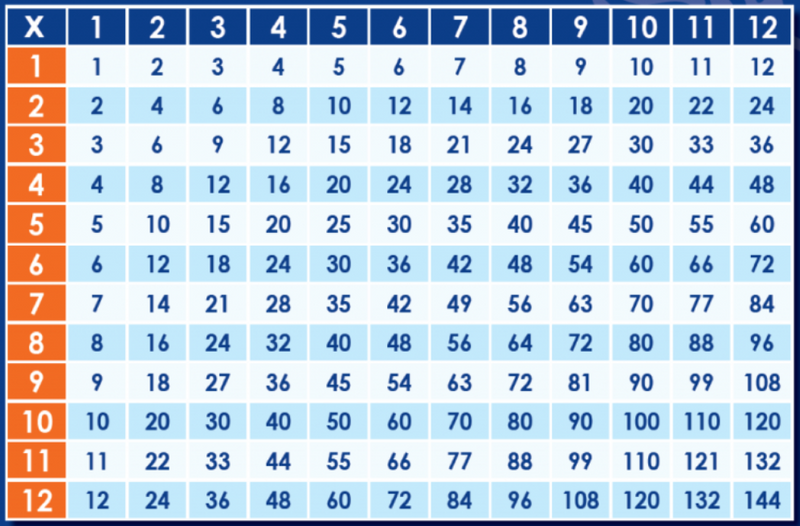
Children need to spend time at home practising their times tables. Children can prepare for the times table challenge and aim to achieve their best times. Don't forget to visit the Times Tables Rock Stars website to help them practise their tables and earn coins to promote their band! It is their challenge this year to top the leader board and help their band to win the Battle of the Bands.
MTC (Multiplication Tables Check)
The children in Y4 will be completing a Multiplication Table Check in June. You can find out moreinformation about the MTC below our homework menu.
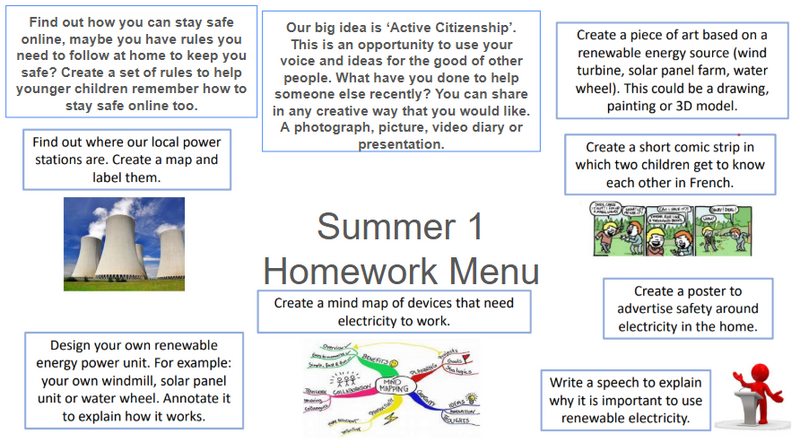
Homework Menu
As part of our wider curriculum, children can also choose to complete homework from our homework menu (see below). This is optional; however, completing homework will allow children to take their learning further and share it with you at home. Once any tasks have been completed please bring them into school for us to look at.
Below, you can also find information about the times table check that children will be completing as well as the statutory words that children should be able to read and spell by the end of Year 4. Learning these words would be a really useful piece of homework.
Spelling
These are the list of statutory words that children need to be able to read and spell by the end of Year 4. The moreyou practise the more you will know! You could practise these words at home by handwriting them, asking an adult to test you or using some of the spelling strategies we have learnt in school.
Other Useful Information
P.E.
Please ensure that your child comes to school in their P.E. uniform on PE days. Our PE days are Monday and Friday.
Indoor Kit = plain white t-shirt, shorts or tracksuit bottoms and suitable shoes (pumps or trainers)
Outdoor Kit = tracksuit bottoms and warm jacket and shoes suitable for the outdoors (trainers)
Please remember that no jewellery should be worn and earrings MUST be removed by children before P.E. Long hair also needs to be tied back.
![]() |
![]() |
USEFUL WEBSITES:
This website has a good range of free games to practise phonics and decoding skills.
http://www.sentenceplay.co.uk/
This has a good range of games which support your child’s spelling and grammar skills.
This is a fun and competitive way for your child to learn their times tables. Look out for new competitions and challenges. Try to top your class leader board.